



I spent three weeks testing premium recliners in Sydney and Melbourne showrooms, swapping between full-body massage units and powered cinema recliners after runs and during long streaming sessions.
If you want recovery in 15 to 30-minute bursts, a massage chair gives you the most relief per session. If you sit for multi-hour sports and movies, a home theatre chair delivers steadier comfort and better viewing ergonomics.
Most buyers get stuck on spec sheets and miss the practical constraints that decide satisfaction, session length, room acoustics, and five-year ownership cost in Australia.
Use the comparisons below to match chair type to your routine, your room layout, and your rights under Australian Consumer Law, including ACCC-backed consumer guarantees.
Key Takeaways
Pick your chair by session length first, then confirm it works with your room and speaker geometry.
- Massage chair equals active relief for short sessions; home theatre chair equals passive comfort for long sessions. Session length is the fastest, most accurate filter.
- Seated ear height drives audio quality. Dolby guidance relies on speakers aligning with ear level, and tall headrests can blunt surround cues.
- Space dictates your shortlist. Wall-hugger theatre recliners can need as little as 152 mm rear clearance, while massage chairs need full recline depth and footwell room.
- Australian price bands overlap. Massage-chair pricing runs from under $1,000 to $12,000-plus; theatre seating commonly lands between about $2,500 and $10,000-plus.
- Consumer guarantees can outlast written warranties. Under Australian Consumer Law, the seller must fix major faults, even if the manufacturer drags its feet.
- Test with your own use-case. Check roller noise during quiet dialogue, headrest height versus surrounds, and full recline depth versus walkways.
What Each Chair Type Actually Is
These chairs both recline, but they’re built to solve different problems.
A massage chair is a powered recliner built around a roller track that applies mechanical pressure along your back and hips. Tracks are usually S-track (spine-shaped), L-track (extends into glutes), or SL-track (a blended curve), and most units add airbags for compression, heat modules, and body-scanning sensors.
Programs are typically timed for 15 to 30 minutes because the chair is doing active work on tissue and joints. The goal is targeted relief, not all-day sitting comfort.
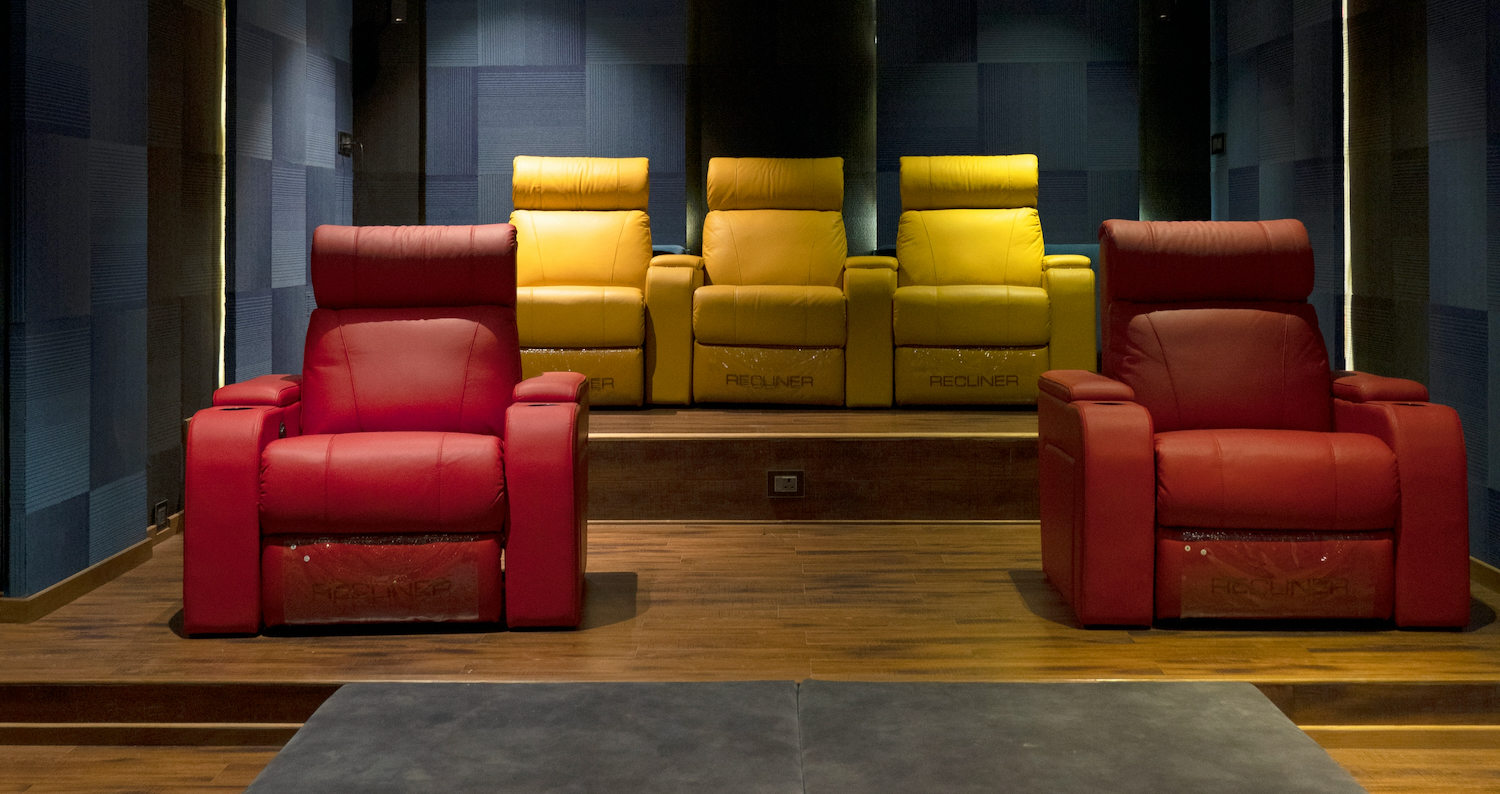
A home theatre chair is a cinema recliner designed for stillness over hours. Expect modular rows, a chaise-style footrest, cupholders, and powered headrest and lumbar adjustment that help you keep a consistent viewing posture.
Some theatre chairs add vibration or mild heat pads. Treat that as a convenience feature, not a replacement for rollers and airbags.
Comfort Science That Actually Matters
Three factors, posture, pressure, and audio geometry, determine whether a chair feels good after hour two.
Spine and posture. Aim for neutral lumbar support and a knee angle around 90 to 100 degrees. Past 60 minutes, stable head and neck support matters more than “plushness,” which is why theatre chairs tend to feel better for long sessions.
Pressure distribution. Rollers and airbags create focused pressure on paraspinal muscles (the muscles beside your spine), glutes, and calves. Theatre chairs spread load through broader cushions and adjustable lumbar, which reduces hot spots during multi-hour sitting.
Audio and screen geometry. Dolby-style layouts assume your ears aren’t buried in a tall headrest that blocks side and rear cues. THX-style guidance also ties viewing comfort to screen height and distance, so you can keep your line of sight close to the screen’s centre without craning your neck.
Room and Installation Planning
Measure access, clearance, and power before you narrow your shortlist.
Clearance. Wall-hugger theatre recliners can fully recline with minimal rear gap, sometimes around 152 mm depending on the mechanism. Massage chairs usually need noticeably more depth once the back tilts and the leg section extends, plus space so you can walk past safely.
Access and weight. Full-body massage chairs can exceed 100 kg, which changes delivery, stairs, and apartment lift logistics. Ask whether the chair ships in split sections and measure your narrowest doorway, not your hallway.
Power and noise. Both types need a nearby general power outlet, but massage-chair models draw more during operation because rollers, pumps, and heat can run together. In a media room, the bigger issue is noise, so run the chair at high intensity in-store while playing quiet dialogue before you commit. If movie-first comfort and modular rows are your goal, Amplify AV’s purpose-built powered recliners, like Home Cinema Chairs, can suit tighter Australian rooms.
Feature-by-Feature Comparison
Use this table to map chair type to how you actually sit at home.
| Factor | Massage Chair | Home Theatre Chair
|
|---|---|---|
| Session length | 15–30 min programs | 2–4+ hours continuous |
| Comfort type | Active roller and compression relief | Passive cushion and lumbar support |
| Space needed | Full recline depth plus footwell | As little as 152 mm from wall |
| Audio impact | Tall back can reduce surround clarity | Lower headrest can preserve ear-level cues |
| Power draw | Higher during use (rollers, pumps, heat) | Mostly during actuation |
| AU price band | Sub-$1K to $12K+ | ~$2.5K to $10K+ |
Costs and Ownership in Australia
Total ownership cost is where “similar price” chairs separate quickly.
Upfront cost. Entry massage-chair models can land under $1,000, but durability and body-scanning quality usually improve sharply above the low end. Premium massage-chair units can exceed $10,000, while home theatre seating tends to scale with seat count, leather grade, and the number of motors per seat.
Electricity. Use this quick estimate: kWh = (watts ÷ 1,000) × hours. Example: a 200 W massage chair used 30 minutes a day is about 3 kWh a month, which is roughly $1.10 at $0.36/kWh. Theatre recliners use meaningful power mainly when moving, so ongoing cost is typically negligible.
Warranty and your rights. Under Australian Consumer Law, consumer guarantees apply automatically and can outlast the written warranty for higher-priced items. If a fault is major, the seller must provide a remedy, so keep proof of purchase and report issues in writing.
Materials and maintenance. CHOICE has noted that leather labelling isn’t standardised in Australia, so confirm what “leather” means, where it’s used, and what’s synthetic. For massage-chair units, ask how long the retailer expects rollers, airbags, and control boards to be supported, and whether service is in-home or depot-based.
Who Should Buy What
Your routine should decide this, not the longest feature list.
Choose a massage chair if you want structured recovery sessions, you carry consistent tension in traps, low back, or calves, and you’ll use heat, compression, and stretch programs most days. It’s a strong fit for runners, shift workers, and desk-bound roles where the same tight areas flare up.
Choose a home theatre chair if you watch in long blocks and care about stable posture for dialogue clarity, screen height comfort, and surround imaging. It also wins when you need a multi-seat row for family and guests.
Mixed households. A common solution is one massage chair for recovery plus a two or three seat theatre setup for viewing. If you’re serious about audio, putting the massage chair in a separate room avoids tall backs and mechanical noise in the cinema space.
Test-Before-You-Buy Checklist
A five-minute demo can reveal problems you’ll hate after five months.
- Fit: Check that rollers, headrest, and lumbar support align to your body without forcing your chin forward.
- Noise: Run maximum intensity, then listen for pump and roller noise during quiet dialogue at your normal night volume.
- Audio: Sit as you would at home and notice whether the headrest blocks your ears from side and rear sound.
- Space: Measure full recline depth, wall clearance, and walkway width with the footrest fully extended.
- Service: Ask about in-home repair, parts lead times, and who pays call-out fees inside and outside warranty.
- Energy: Confirm rated watts for maximum use and standby, then run the kWh calculation using your real tariff.
Explore Massage Recliner Chairs for Daily Recovery
A dedicated massage chair makes sense when you’ll use structured programs most days.
Relax For Life offers L-track and SL-track designs, heat therapy, body-scanning, and targeted programs aimed at back and lower-body tension, which makes it easier to match roller reach to your height and daily tight spots. If your goal is repeatable recovery sessions and focused muscle-tension relief, their full range of massage chairs is designed to fit apartments as well as larger homes.
Explore Home Cinema Theatre Chairs for Movie-First Comfort
Dedicated theatre seating wins when you want consistent posture and modular seating for long sessions.
Amplify AV offers home cinema theatre chairs with power headrest and lumbar adjustment, LED cupholders, and wall-hugging mechanisms designed for tighter Australian rooms. Modular rows also make it easier to keep seated ear height aligned with Dolby and THX-style speaker placement.
Safety and Health Notes
Comfort products can help, but they don’t replace clinical advice for persistent pain.
Massage chair cautions: Use conservative settings if you bruise easily, and avoid prolonged heat if it aggravates inflammation. If you’re pregnant, have an implanted medical device, or have clotting risk, get clinician guidance before using powered massage.
Theatre chair cautions: Motorised footrests can pinch, so supervise kids, keep walkways clear, and don’t let two people share one seat in recline.
Verdict and Buyer Paths
Choose by session length first, then confirm the chair fits your room and audio plan.
If your priority is recovery and you’ll use timed programs, invest in a massage chair. If your priority is long viewing sessions with stable posture, invest in theatre seating with good head and lumbar adjustment.
Apartment cinephile: A wall-hugger two-seat theatre lounge, plus a compact massage unit in a bedroom, keeps the media room quiet and properly laid out.
Runner with tight calves: A full-body massage chair that includes strong calf work, paired with simpler lounge seating for casual viewing, keeps spend focused on recovery.
Measure your space, bring familiar content to your demo, and test comfort at the same recline angle you’ll use at home.
