

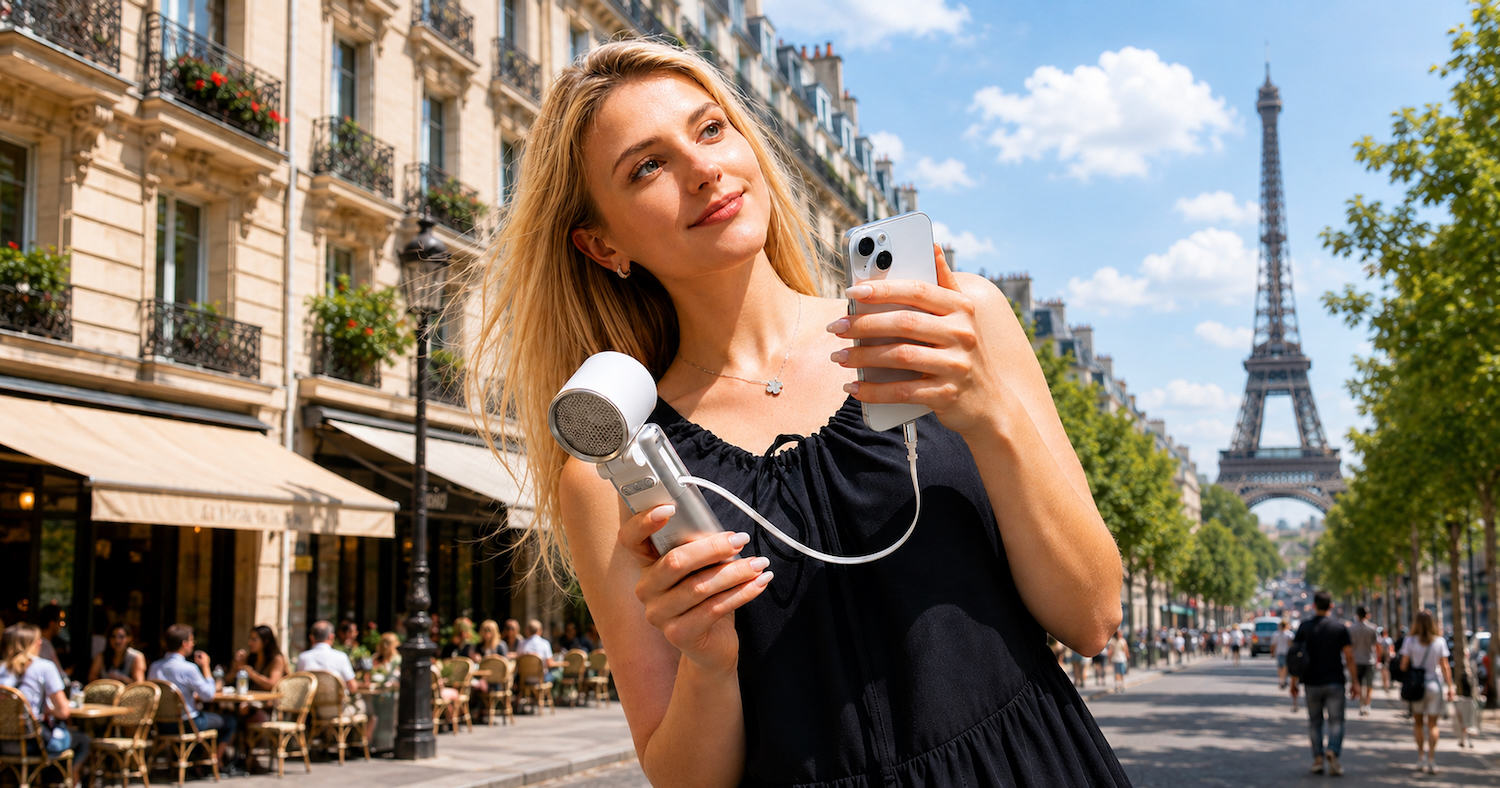


If your winter escape involves chasing the northern summer, be ready for more heat than you might be expecting. Europe has just come through its most severe heatwave on record, with France topping 44 degrees Celsius and records falling across the UK, Spain, Germany and plenty of other places.
The US has copped it too, with heat alerts across the eastern half of the country and some cities pushing 40 degrees Celsius, or the low 100s in Fahrenheit.
The part a lot of travellers underestimate is that air conditioning is not a given over there, especially in Europe where only about one in five homes has it. That heat follows you around all day when you are sightseeing: queues outside museums, packed train platforms, walking tours with no shade in sight. A bit of personal cooling gear in your daypack makes a genuine difference, and most of it is small, cheap and easy to pack. Here is what actually earns its spot.
First, what a fan really does
Worth being straight about this, because it changes how you use one. A fan does not chill the air like an air conditioner. What it does is move air across your skin so sweat evaporates faster, and that is what makes you feel cooler. It works best in humid heat. In very dry, extreme heat up above the high 30s, a fan is mostly just pushing hot air at you and does far less, which is why health authorities tell people not to rely on a fan alone when it is truly scorching. Think of it as one part of your kit alongside shade, water and rest, and it pays for itself many times over on a normal hot day.
Pick the right type of fan for how you travel
Handheld fans are the obvious starting point and they are everywhere for a reason. A small portable fan lives in a bag or a pocket and gives you an instant hit of air when you stop for a coffee or wait for a train. The only catch is that you have to hold it, so one hand is always busy.
If you would rather keep your hands free for your phone, your gelato or your kids, look at the wearable options. Neck fans loop around your neck like a pair of headphones and push air up towards your face and collar. A waist fan clips onto your belt or waistband and sends air up your torso, which sounds a bit odd until you have worn one on a long, sweaty walk and realised how well it works. For full days on your feet, that is my pick, because after five minutes you forget it is even there.
Whatever type you go for, battery life is the spec that matters most on the road. The last thing you want is your fan dying before lunch on the hottest day of the trip. Look for a large battery and an honest all-day runtime on the lower speeds, plus a USB-C charge port so you can top it up from the same charger as your phone. Some fans also throw in a USB output so they can act as an emergency phone charger when you are in a pinch. Handy to have, though I would not lean on it as your actual power source, which brings us to the next thing worth packing.
Sort out a proper power bank (the rules changed this year)
A power bank is the one piece of tech I would never travel without, and the rules around them have tightened in 2026, so it is worth getting right before you get to the airport. Across most major airlines, power banks now have to travel in your carry-on and never in checked luggage. There is a capacity limit of 100 watt hours, which is roughly 27,000mAh, before you need airline approval, and a growing list of carriers, including Qantas, Jetstar and Virgin Australia, now want them kept within reach rather than up in the overhead bin. Several airlines have also brought in restrictions on using or recharging them mid-flight, so have a quick look at your carrier’s policy before you fly.
For most travellers a 10,000mAh charger is the sweet spot. That works out to only about 37 watt hours, so it sits comfortably under the airline limit, it is small enough to carry all day, and it will give a phone roughly two full charges, which is plenty for a day of maps, photos and boarding passes. If you want one to keep in the daypack, a compact certified travel power bank like this will cover the fan, the phone and a set of earbuds without weighing you down.
A few cheap extras that punch above their weight
A cooling towel that you wet and wring out gives you an instant cold compress for the back of your neck and costs next to nothing. An insulated bottle keeps your water properly cold for hours, which matters more than it sounds when the tap water is warm and you are rationing sips. Loose, light coloured clothing in natural fabrics beats anything synthetic and clingy, and a broad hat with a decent pair of sunglasses will save you on the days with no shade anywhere.
One last tip, and this one is free: do the heavy sightseeing early in the morning or in the evening, and treat the middle of the day as downtime. The locals plan their day around the heat like that for a reason, and you will get more out of the trip if you copy them.
None of this is complicated or expensive, and it all packs down to almost nothing. Get a decent fan, a reliable power bank and a couple of low tech extras sorted before you go, and the heat turns into a background detail rather than the thing you remember most about the holiday. Enjoy the trip.
Frequently asked questions
Can I take a power bank on a plane to Europe or the US?
Yes, but in your carry-on only. Power banks are banned from checked luggage on every major airline. Keep it under 100 watt hours, which is about 27,000mAh, and you will not need approval. In 2026 a number of carriers, including Qantas, Jetstar and Virgin Australia, also want power banks kept within reach rather than in the overhead bin, and some restrict using or recharging them mid-flight, so check your airline’s policy before you fly.
What size power bank is best for travelling?
For most people 10,000mAh is the size that works best. It is around 37 watt hours, so it sits well under the airline limit, it is small enough to carry all day, and it gives a phone roughly two full charges. If you are also running a fan and a set of earbuds, that capacity still gets you comfortably through a day of sightseeing.
Are neck fans or waist fans better for travel?
Both keep your hands free, which is the main advantage over a handheld. Neck fans sit around your collar and aim air at your face, so they are good when you are sitting or standing still. Waist fans push air up your torso and tend to suit long walking days better because the airflow moves with you. If you are on your feet most of the day, a waist fan is the one I would pack.
Do portable fans work in really hot weather?
Up to a point. A fan helps your sweat evaporate, so it makes you feel cooler in normal and humid heat. Once the temperature climbs into the high 30s and the air is very dry, it does much less, because it is really just moving hot air around. On those days, use it alongside shade, cold water and rest rather than counting on it on its own.
How do I stop my fan running out of battery during the day?
Buy one with a large battery and check the runtime on the lower speeds rather than the maximum figure on the box. Run it on low or medium for most of the day and save the top speed for when you actually need it. A USB-C port lets you top it up from your phone charger, and some fans can even borrow charge from a power bank while you keep walking.
