

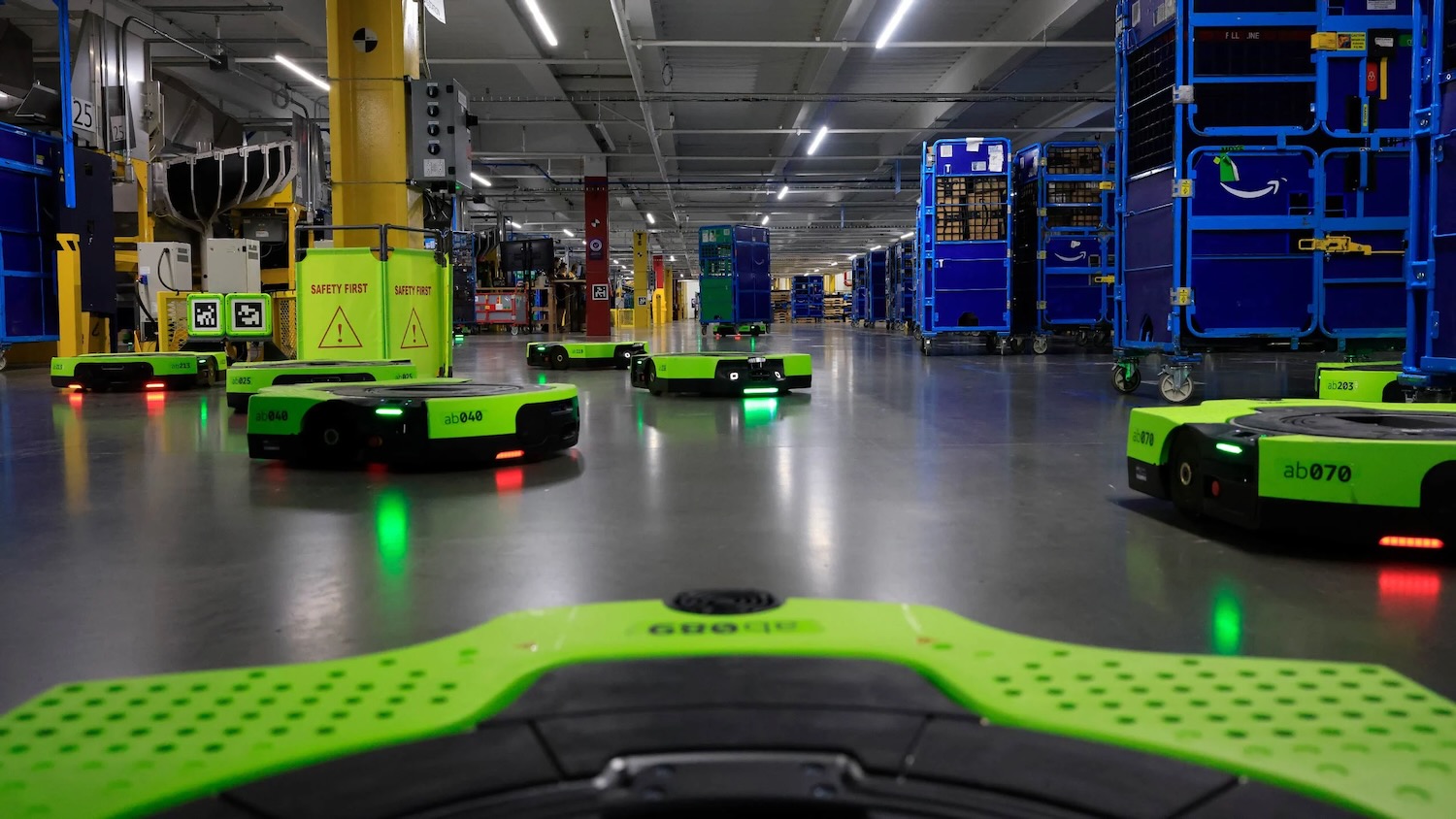


Amazon has unveiled the next generation of its Proteus autonomous robots at its Delivering the Future event in London which have been designed to respond to natural language and improve its efficiency and capabilities.
The next-gen Proteus robot will be deployed across Amazon’s European fulfilment centres as part of a £10 billion investment before eventually making its way to Australia’s fulfilment centres in the near future.
Proteus is designed to take on physically demanding tasks, including moving heavy carts and covering distances, so associates can focus on more highly skilled tasks like quality control and the flow of inventory.

Amazon employees will be able to talk to Proteus in the same way that they communicate with a colleague using plain conversational language and without the need to refer to a programming interface.
Currently Proteus operates mainly in dock areas within the fulfilment centres and can navigate safely around people while transporting heavy carts that can weigh up to 400 kg.
The latest generation of Proteus can do much more and go much further and operate in more areas wherever items need to be moved.
This includes shifting containers as they arrive on site and transferring them between workstations while assisting employees across the fulfilment centres and delivery sites.
And because of the advances in AI, the next-generation Proteus can understand natural language and be assigned tasks by employees simply by asking it as they would when talking to another employee.

“You tell it what needs to be done. It figures out the priority, the route, the timing,” said Scott Dresser, vice president of Amazon Robotics.
“It becomes your assistant for material movement.”
Other innovations unveiled at the event include STARK and Vulcan.
Stark is a new robotic tote handling system and was the result of an employee’s idea to improve a process and support increased site safety.
Stark works alongside employees, picking up full totes from conveyors and placing them on carts.
This work would otherwise require repetitive heavy lifting.
Stark was first deployed in Barcelona, Spain, and will be expanded to sites across Europe by 2027.

Vulcan is another innovation that will be used to support a growing number of sites.
This is Amazon’s first robotic system with a sense of touch that can see and feel objects at the same time and navigate densely packed environments.
After being developed in Spokane, Washington, Vulcan has been able to handle more complex picking tasks at Amazon’s Hamburg facility in Germany.
“This transformation is designed to deliver a step-change in how we support our employees and serve our customers,” said Armin Cossmann, vice president of operations for Europe.
“Customer expectations aren’t slowing down—and neither are we.”
Despite the massive investment in robotics Amazon has also making a massive commitment to people looking to expand their skills in a changing workforce.
* Stephen Fenech travelled to London as a guest of Amazon
