




Gen, the company behind internet security leader Norton, says Australia has become one of the world’s biggest targets for AI driven scams.
In its Q4 Gen Threat Report, it was revealed Australians are increasingly being tricked with scams delivered through ads, shopping feeds, social media and videos.
And these attacks succeeded when Australians completed the last step themselves by either clicking a link, scanning a QR code, approving a device pairing or entering a verification code.
“Increasingly throughout 2025, scams did not announce themselves as threats. They blended into everyday digital routines,” said Siggi Stefnisson, Cyber Safety CTO at Gen.
“Attackers leaned on familiar platforms, trusted interfaces, and automated persuasion, then scaled those tactics across devices and channels.”
Scan activity rose by 51 per cent in Q4 year on year with the top threats being e-shop scams (up 258 per cent), gambling scams (up 167 per cent) and financial schemes (up 143 per cent).
This demonstrates the move by cybercriminals to embed the scams inside everyday activities like shopping, entertainment and payments.
It also increased in another area where people spend a lot of time – in social feeds and videos.
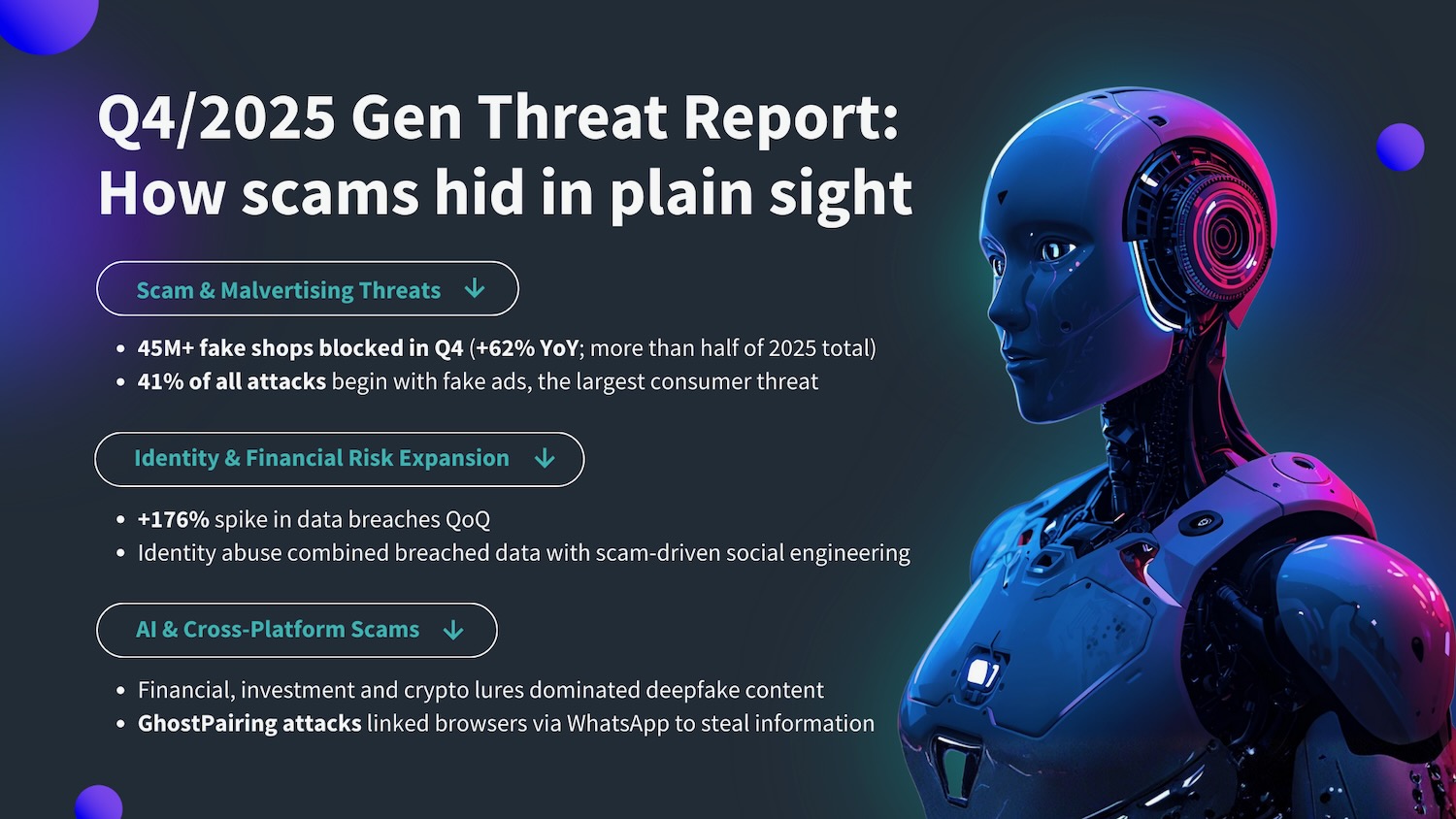
Fake online stores popped up during the holiday season with Gen blocking more than 45 million fake shop attacks in Q4 alone.
That is a 62 per cent increase from the same period in 2024.
Fake stores accounted for 65 per cent of all threats blocked on social media with a heavy concentration on Facebook and YouTube where most of the risky shopping clicks originated.
Phishing scams were also seen across platforms led by Facebook (77 per cent) followed by YouTube (13 per cent).
The issue for users was that scams felt indistinguishable from ordinary ads and posts on the platforms.
The full Gen Q4 Threat Report can be read here.
